
Key facts
- Refractive surgery corrects myopia (up to −10 D by laser, −18 D with ICL implants), hyperopia (+6 D), astigmatism (6 D) and presbyopia, from age 23 with a prescription stable for 2 years.
- Three laser techniques: SMILE Pro (10 seconds of laser per eye, micro-invasive), LASIK (recovery in 24–48 h), PRK (thin corneas, recovery 5–7 days).
- Painless under anaesthetic drops; back to work in 1 to 3 days depending on the technique.
- Not covered by French social security; a detailed quote is provided before any decision.
Understanding refractive errors
Myopia
The eye is too long: distant objects are blurry, near vision stays sharp. About 30 % of European adults are myopic.
Hyperopia
The eye is too short: sustained near work is tiring, with eye strain and headaches, especially after 30–35.
Astigmatism
The cornea is oval rather than round (rugby-ball shaped): vision is blurred and distorted at all distances.
Presbyopia
Age-related loss of near focusing, from around 40–45. Treatable by laser monovision or lens implants.

The cornea: where the correction happens
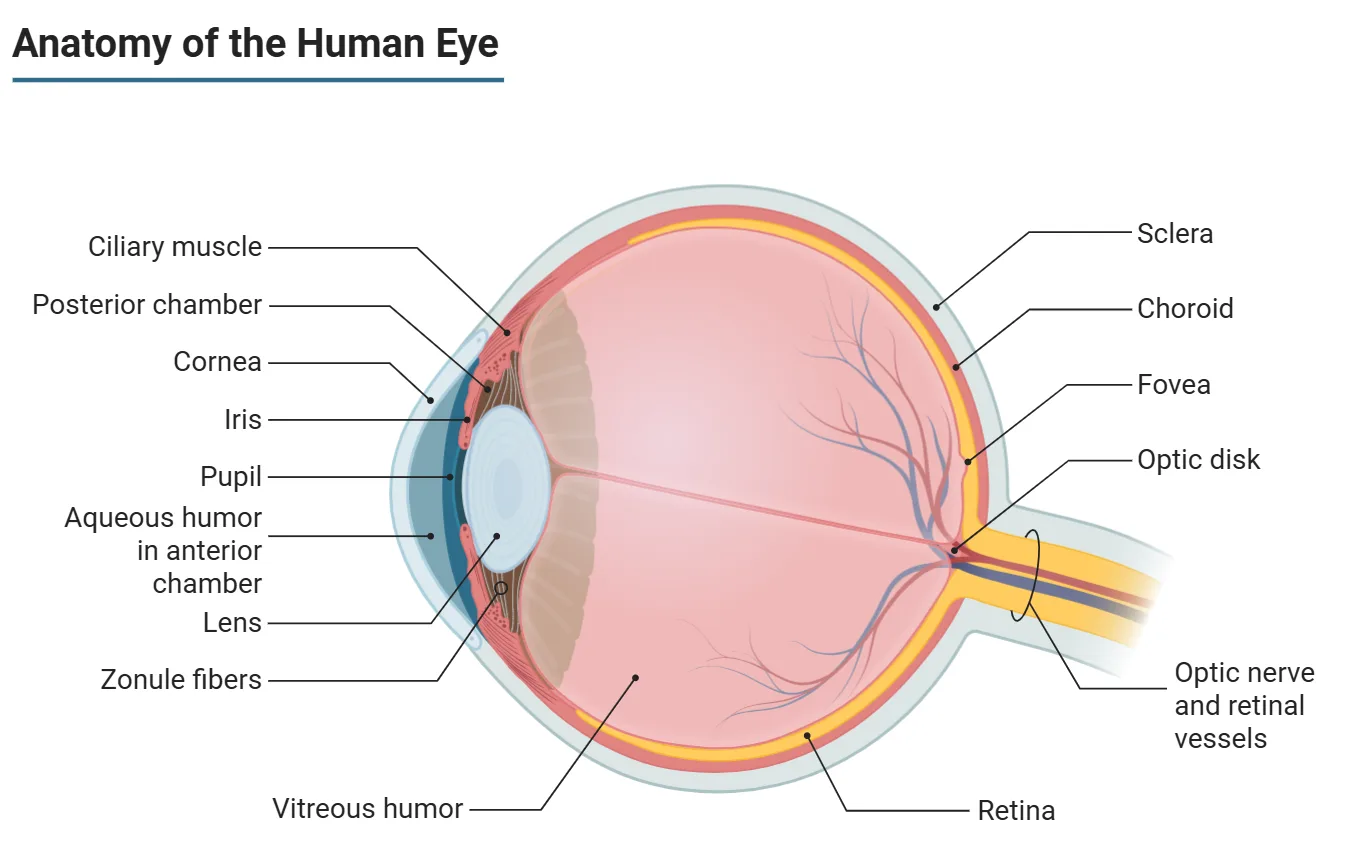
The cornea is the transparent window of the eye — about 11.5 mm across and 540 microns thick at the centre — and provides two thirds of the eye’s total focusing power. Laser vision correction works by reshaping it with sub-micron precision. Its five layers (epithelium, Bowman’s membrane, stroma, Descemet’s membrane, endothelium) explain the differences between techniques: PRK works on the surface, LASIK and SMILE inside the stroma.

The four techniques
The technique is never chosen at random: it follows from your prescription, corneal thickness and shape, pupil size and profession, all measured during the pre-operative work-up.
SMILE Pro
Small Incision Lenticule Extraction — Zeiss VISUMAX 800
The most recent technique. The femtosecond laser cuts a thin lenticule inside the cornea in 10 seconds, extracted through a 2–4 mm micro-incision. No corneal flap — corneal strength and nerves are preserved, with markedly less dry eye than LASIK.
- Myopia to −10 D, astigmatism to −5 D
- Functional vision within 24–48 h
- Satisfaction > 98 % in published studies
LASIK
Laser-Assisted In Situ Keratomileusis
The reference technique for over 25 years. A femtosecond laser creates a thin corneal flap; an excimer laser then reshapes the cornea beneath it with sub-micron precision. The flap self-seals in minutes without sutures.
- Myopia to −8 D, hyperopia to +5 D, astigmatism to −5 D
- Sharp vision from the next day in most cases
- Easy enhancement by re-lifting the flap
PRK (surface laser)
Photorefractive Keratectomy / trans-PRK
The corneal surface layer is removed and the excimer laser applied directly — no flap at all, maximum residual corneal strength. A bandage contact lens protects the eye for 4–5 days.
- Ideal for thin corneas and contact-sport or high-risk professions
- Discomfort for 48–72 h, vision stabilises over 1–3 months
ICL implant
Implantable Collamer Lens
A biocompatible lens placed inside the eye between the iris and the natural lens, through a 2.8 mm incision. The cornea is untouched and the procedure is fully reversible.
- Myopia to −18 D, hyperopia to +10 D
- Sharp vision from the next day; satisfaction > 99 % (FDA studies)
- The solution for prescriptions beyond laser range or thin corneas
Where does surgery take place? The pre-operative work-up and all follow-up visits happen at IPO. The laser procedures themselves are performed by our surgeons in partner laser centres in Paris equipped with the latest platforms (including the Quinze-Vingts Laser Vision Centre).
The pre-operative work-up
Allow about 1 h 30. Everything is checked: your true prescription (under cycloplegic drops), the shape and thickness of your cornea, and the health of your retina. This work-up determines whether surgery is possible and which technique suits you.
Refraction under cycloplegia
Drops temporarily relax the focusing muscle to measure your exact prescription. Vision stays blurry for a few hours — do not plan to drive, and bring sunglasses.
Corneal topography and tomography
Complete mapping of corneal shape and thickness (Pentacam) to rule out subclinical keratoconus and confirm sufficient residual thickness after treatment.
Retinal examination and OCT
Check of the retina, optic nerve and macula — important in myopic eyes, which carry a higher risk of retinal thinning and tears.
Surgeon consultation
Synthesis of all results, recommendation of the most suitable technique, discussion of benefits and risks, written informed consent and detailed quote.
Contact lens wearers: soft lenses must be removed at least 48 hours before the work-up, rigid lenses 3–4 weeks before, so the cornea returns to its natural shape for accurate measurements.
On the day of surgery
20 min
Total time in theatre for both eyes — the laser itself lasts from a few seconds (SMILE Pro) to about a minute per eye.
Painless
Anaesthetic drops only. You stay awake, go home immediately after a post-operative check, with antibiotic and anti-inflammatory drops for the following days.
The procedure is ambulatory: you arrive about 30 minutes early and leave shortly after. Someone must accompany you — driving is not allowed on the day of surgery.
Risks and side effects
Satisfaction exceeds 96 % in published studies, but no surgery is risk-free. The possible effects, most of them transient:
Dry eye
The most frequent side effect, especially after LASIK (the flap cut sections superficial corneal nerves). Usually transient (1–6 months), managed with artificial tears. SMILE Pro reduces this risk significantly.
Night halos and glare
Possible around lights at night, mainly in large myopic corrections or wide pupils. Fades with neuro-adaptation, rarely bothersome after 3–6 months; modern aspheric profiles reduce it considerably.
Over- or under-correction
The result can differ slightly from target. Usually minor; an enhancement is possible after stabilisation (3–6 months) if the residual corneal thickness allows — simplest in LASIK by re-lifting the flap.
Flap-related events (LASIK only)
Rare folds, displacement or interface inflammation (DLK). Non-existent in SMILE and PRK, which create no flap — one reason those techniques are preferred for contact sports.
Corneal ectasia
Progressive corneal deformation — the most feared complication, but exceptional. Preventing it is exactly why the pre-operative work-up is so rigorous: Pentacam topography and tomography on every patient rule out at-risk corneas (subclinical keratoconus, thin corneas). Not rubbing your eyes matters too.
Infection and haze
Post-operative infection is exceptional (< 0.01 %). Haze (faint corneal opacity) is specific to PRK in large corrections and is prevented by applying mitomycin C during the procedure. Rigorous follow-up minimises both.
Eligibility
- Age 23 or over (an information consultation is possible earlier)
- Stable prescription for at least 2 years (variation under 0.50 D)
- No evolving keratoconus, uncontrolled autoimmune disease, or current pregnancy/breastfeeding
Only a complete work-up can confirm eligibility. You can also try our 5-question eligibility quiz (in French).
Frequently asked questions
Is laser eye surgery painful?
No. It is performed under anaesthetic eye drops; you feel light pressure at most. SMILE Pro takes about 10 seconds of laser per eye. Mild scratchiness and watering for a few hours afterwards are normal.
Are both eyes treated the same day?
Yes — bilateral same-day treatment is the standard of care for SMILE Pro and LASIK, validated by the scientific literature.
How quickly can I fly home after surgery?
After SMILE Pro or LASIK, flying is generally possible within a few days once the day-1 check-up is satisfactory. After PRK, allow about a week. If you are travelling to Paris for surgery, tell us your dates — we schedule the work-up, procedure and follow-up accordingly.
How much does it cost?
Refractive surgery is not covered by French social security (elective procedure). A detailed personal quote is provided at the pre-operative consultation; many complementary insurance plans contribute 300–1,000 € per eye. Payment plans are possible.
What happens when presbyopia arrives later?
Laser correction of distance vision does not prevent presbyopia, which affects everyone from around 45–50. Solutions then include laser monovision, PresbyLASIK or multifocal implants at the time of cataract surgery.
SMILE Pro, LASIK or PRK — how do I choose?
You don’t have to — the work-up does. SMILE Pro (latest generation) is ideal for myopia and astigmatism: micro-invasive, no flap, ultra-fast recovery. LASIK covers all refractive errors including hyperopia. PRK is preferred for thin corneas and professions at risk of eye impact. Your surgeon recommends the technique after the measurements.
Can the correction regress over time?
In the great majority of cases the result is stable and permanent. Slight regression occurs in under 5 % of cases, mostly after large corrections; an enhancement is then possible once the residual corneal thickness has been checked.
Book a refractive surgery assessment
Meet our refractive surgeons for a personalised work-up and find out which technique suits your eyes — consultations available in English.